
Integrating CIJ Printers with MES and ERP Systems: Bridging the Gap Between Data and Production

Introduction
In modern manufacturing, efficiency relies on the seamless flow of data across multiple systems. Yet in many facilities, operators must still pull information manually from databases or enterprise platforms such as Manufacturing Execution Systems (MES) or Enterprise Resource Planning (ERP) before entering it into individual printers. This process introduces delays, increases the likelihood of human error, and weakens traceability across the production chain.
By connecting continuous inkjet (CIJ) printers directly to MES and ERP systems, manufacturers can eliminate these manual steps. Instead of operators keying in print strings, printers can automatically import validated job data such as lot codes, batch numbers, and compliance markings directly from higher-level systems. The result is a faster, more reliable process where the right information reaches the right product every time.
Beyond convenience, this level of integration transforms coding equipment into part of a larger digital ecosystem. When printers communicate directly with enterprise systems, they not only receive instructions but also send valuable performance data back. The outcome is a fully connected process that enhances quality, compliance, and operational efficiency, which are hallmarks of Smart Manufacturing and Industry 4.0.
From Manual Entry to Connected Automation
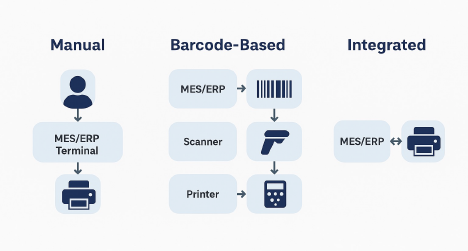
In many plants, marking and coding setup remains a manual process. Operators typically receive production details from supervisors, MES terminals, or printed work orders. They must then configure the printer by entering details such as distance measurements, part numbers, date codes, logos, or compliance marks directly into the CIJ user interface. While workable, this approach consumes time and creates risk: a single mistyped character can lead to thousands of feet of incorrectly marked product, generating scrap, rework, or even customer rejections.
To mitigate these issues, some facilities have implemented barcode-based workflows. Operators scan a barcode linked to a specific work order or job sheet, and the required print string is automatically populated into the printer. This approach significantly reduces input errors and speeds up job changes, especially in facilities running frequent short runs or multiple product types.
Barcode systems have therefore become a common bridge between enterprise data and individual printers, an effective but transitional step toward full digital integration.
Direct Integration: The Next Stage of Efficiency
As manufacturing continues to evolve, barcode-based solutions are no longer the final step. They are an interim measure. The next level of efficiency and control comes from direct integration between coding equipment and enterprise systems such as MES or ERP.
For example, integrating a CIJ printer directly with an ERP platform like SAP enables seamless job data transfer from enterprise systems to the production line. Job data such as product codes, lot numbers, and compliance requirements flows automatically, eliminating manual input. The printer receives the correct information directly from the central database, ensuring perfect alignment between digital records and physical output.
This model not only streamlines job setup but also strengthens accuracy and compliance. With every print instruction sourced from the same central repository, there is no room for mismatched versions, outdated codes, or duplicated data. In addition, the connection enables automatic feedback from the printer to the MES or ERP, allowing real-time updates on job status, line performance, and system health.
In short, integration converts coding from a standalone utility into a synchronized, intelligent node within the production network.
Smart Manufacturing and the Industrial Internet of Things
The shift toward Smart Manufacturing and Industry 4.0 is redefining expectations across all industrial sectors, including wire and cable. At its core, Smart Manufacturing is about connecting equipment, processes, and enterprise systems into a unified digital ecosystem that turns data into actionable intelligence.
For coding and marking, this means transforming printers from independent devices into fully integrated nodes within the Industrial Internet of Things (IIoT). When CIJ printers connect directly to MES and ERP platforms, they automatically receive validated job data, ensuring that every printed identifier corresponds precisely with the digital record stored in central systems.
This level of integration closes a long-standing gap in traceability. Every marked product, whether a length of cable, pipe, or tubing, can be tied back to a specific order, batch, or production run. If a problem arises in the field, the manufacturer can trace it back instantly to its production parameters, date, and even the operator responsible.
Compliance and Traceability Advantages
Regulatory and customer requirements across electrical, telecom, and industrial cabling sectors demand precise, durable, and traceable product identification. Directly linking coding systems to enterprise platforms eliminates transcription errors, reduces audit risk, and enables faster and more confident reporting.
When a regulator or customer requests documentation, manufacturers can immediately demonstrate that the physical markings on each product correspond to digital production records. The ability to produce such proof, often within seconds, significantly strengthens audit readiness and customer confidence.
In highly regulated industries, this level of alignment can be the difference between a successful audit and a costly non-compliance finding. It also simplifies compliance with standards that require serialized or date-coded identification, enabling consistent, verifiable, and repeatable processes across production sites.
Operational Efficiency and Real-Time Control
Direct integration also drives measurable efficiency gains. Automated job setup reduces changeover time and minimizes operator involvement, allowing staff to focus on higher-value tasks. Production managers can remotely monitor printer status, adjust settings, or initiate new jobs without interrupting the line. Multi-line facilities can coordinate changeovers across all machines simultaneously without the lag or inconsistency of manual entry.
The result is smoother workflow, shorter downtime, and increased throughput. Moreover, standardized data ensures consistent performance across locations, helping global manufacturers maintain uniform quality standards from plant to plant.
In many cases, the integration of printers into MES and ERP environments becomes a stepping stone toward broader digital transformation. As production assets become interconnected, managers gain visibility not just into individual machines but into the entire process chain, from scheduling and materials to finished product verification.
Predictive Maintenance and Data-Driven Insights
One of the most powerful outcomes of printer integration is the availability of operational data for analytics. Connected printers generate a steady stream of information such as ink consumption, nozzle performance, error logs, and temperature readings that can be captured and analyzed in real time or aggregated across a fleet.
By feeding this data into analytics or maintenance platforms, manufacturers can identify performance trends and predict potential failures before they occur. For example, if a printer shows a gradual increase in nozzle cleaning frequency or ink viscosity variation, maintenance teams can schedule intervention proactively rather than waiting for an unplanned shutdown.
This predictive approach reduces downtime, extends equipment lifespan, and stabilizes production output. Over time, such insights also help manufacturers optimize consumable usage, balance workloads across lines, and identify systemic issues that might otherwise go unnoticed.
In this model, CIJ printers evolve from peripheral devices into strategic assets, tools that not only mark products but also deliver data that support continuous improvement.
Case Study: Digital Transformation in Wire and Cable Manufacturing
A mid-sized North American wire and cable manufacturer recently launched a digital transformation initiative aimed at improving efficiency and reducing waste. One of the first processes targeted was product coding, a recurring source of errors, downtime, and rework.
Historically, operators received work orders from scheduling, entered print strings manually into CIJ printers, and performed visual checks for accuracy. Although functional, the system was inefficient. Mistyped codes, outdated batch data, or incorrect settings frequently led to misprinted cable and costly scrap.
The company partnered with its coding equipment provider to integrate CIJ printers directly with its enterprise SAP system. Job data, including product specifications, batch numbers, and compliance information, was automatically retrieved from SAP and transmitted to the printers. Operators were no longer responsible for manual data entry. Their role shifted to verifying that the correct job was active before production began.
The results were immediate and measurable:
70 percent reduction in coding-related errors, leading to a substantial drop in scrap and rework.
30 percent decrease in setup time, as job changeovers were initiated directly from the MES or ERP interface.
Improved traceability and compliance, with every printed product tied directly to its corresponding SAP record.
During a customer audit, the facility demonstrated full digital traceability from order to physical product, earning commendation for best practices. The success of this integration prompted the company to expand the model across additional production lines and facilities.
By connecting coding systems to SAP, the manufacturer transformed a long-standing pain point into a competitive advantage. What was once a manual, error-prone process became a connected, intelligent workflow that reduced waste, improved product quality, and aligned with the company’s broader Smart Manufacturing vision.
Implementation Roadmap
For manufacturers considering a similar transformation, a structured approach ensures success and scalability. The following steps provide a practical roadmap:
Assess Current Workflows
Identify manual entry points, redundant data handling, and bottlenecks in coding operations. Document where errors or delays most often occur.Evaluate Technology Compatibility
Choose printers and software that support open communication protocols and integration with MES and ERP platforms. Ensure that both hardware and software vendors can collaborate effectively.Pilot on a Single Line
Begin with one production line to validate data flow, confirm print accuracy, and measure improvements in setup time and error rates before full deployment.Implement Analytics and Reporting
Use integration to collect and analyze performance data. Monitor KPIs such as error reduction, uptime, and maintenance intervals to demonstrate ROI and guide further optimization.Train and Transition Staff
Educate operators, technicians, and managers on new workflows. Reinforce how integration improves accuracy, simplifies their responsibilities, and contributes to larger business goals.
By following these steps, manufacturers can minimize disruption, secure internal buy-in, and achieve measurable benefits within months of implementation.
Conclusion
Integrating continuous inkjet printers with MES and ERP systems transforms coding and marking from a manual, error-prone task into a seamless, data-driven process. As demonstrated in real-world applications, direct connection with enterprise platforms such as SAP dramatically reduces coding errors, scrap, and rework while improving uptime, compliance, and traceability.
Beyond operational gains, integration creates a foundation for continuous improvement. Connected printers feed valuable data back into the enterprise ecosystem, enabling predictive maintenance, better resource planning, and richer insight into production performance.
In essence, coding equipment evolves from a peripheral utility to a strategic, intelligent asset that strengthens efficiency, enhances product quality, and advances the goals of Smart Manufacturing and Industry 4.0.